

Disruptive Innovations Shaping the GLP-1 Landscape

As type 2 diabetes and obesity reach epidemic proportions globally, glucagon-like peptide 1 (GLP-1) therapies have emerged as a transformative force in modern medicine.
Recent findings highlight their expanding therapeutic potential beyond glucose control and weight management, with research exploring new roles in neurodegenerative disease, chronic kidney and liver disease, cardiovascular protection and addiction treatment.
Surging global demand for GLP-1 therapies is driving innovation across the biopharmaceutical landscape. PDA Week 2025 opened with a timely and insightful plenary session, “From Manufacturing Excellence to Patient Impact: The Future of GLP-1 Therapies,” where thought leaders from industry and patient care explored the disruptive breakthroughs shaping this evolving field — from advances in GLP-1 therapeutics to innovative manufacturing technologies and evolving quality strategies.
Moderated by Vanessa Vasadi Figueroa (VVF Science), the session featured key insights from three expert speakers:
- Innovations in peptide synthesis and continuous processing that are redefining pharmaceutical manufacturing efficiencies (Lorraine O’Shea, Eli Lilly and Company)
- Optimizing GLP-1 therapies to improve outcomes across diabetes and obesity care (Lucia Novak, Diabesity LLC)
- Innovative quality management strategies that are ensuring global patient access to lifesaving GLP-1 medicines (Melissa Seymour, Eli Lilly and Company)
The Future of GMP Manufacturing: Disruptive Technologies in Peptide Synthesis and Continuous Processing
Lorraine O’Shea, Eli Lilly’s Small Molecule and Peptide Plant Manager in Cork, Ireland, opened the plenary session with a description of the manufacturing innovations introduced by her team to respond to the soaring global demand for GLP-1 therapies.
Tasked with building a manufacturing facility capable of producing five metric tons per year of tirzepatide (the GLP-1 used in Mounjaro and Zepbound) — and given only three years to complete the project — O’Shea’s team leveraged a series of disruptive technologies that have set a new benchmark for pharmaceutical manufacturing:
- Novel Hybrid Synthesis Platform: The facility uses solid-phase peptide synthesis (SPPS) to build peptide fragments of 6–14 amino acids in length. Liquid-phase peptide synthesis (LPPS) is then used to couple the pre-made peptide fragments. As well as slashing production times, this novel methodology allows parallel production of peptide fragments at multiple “global supply nodes,” creating a resilient, scalable supply chain.
- Plug Flow Reactors: Plug flow reactor technology was adapted to enable continuous peptide coupling reactions, replacing the start-and-stop methodology of traditional batch processing. As well as accelerating production, the technology eliminates the need for large-volume batch reactors, reducing the equipment footprint and capital costs while enabling scalable production.
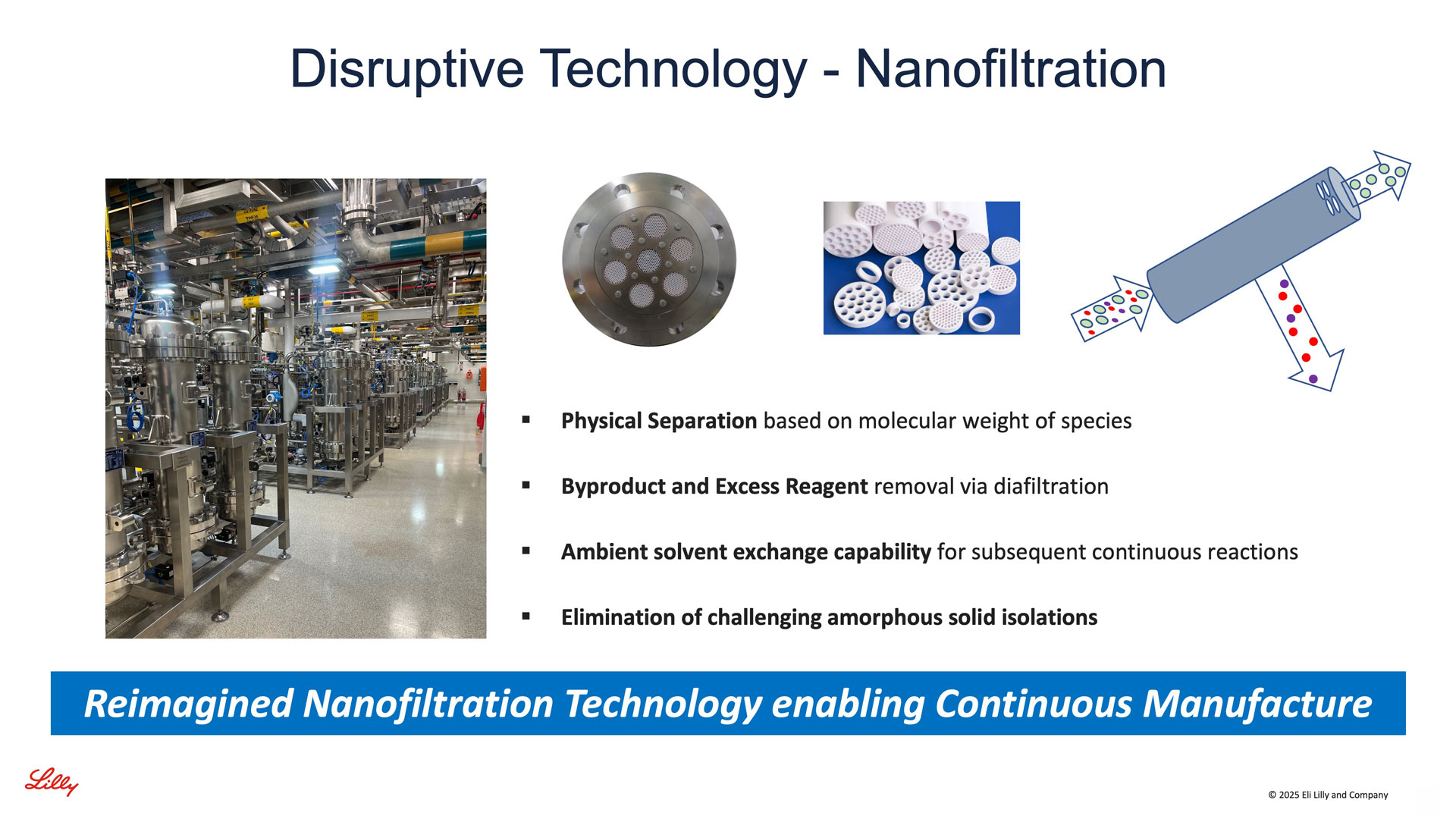
- Nanofiltration Technology: The team applied nanofiltration technology — a technique that Lilly had prior experience with for monoclonal antibodies but which had never before been used in peptide manufacturing — to remove excess reagents and byproducts while seamlessly exchanging solvents between steps. This eliminated the need to isolate and dry intermediates, creating a fully telescoped process. Described by O’Shea as the “jewel in the crown” of the facility’s disruptive manufacturing strategy, this innovation not only accelerated throughput but also ensured consistently high peptide purity and yield.
- Process Analytical Technology (PAT): An autonomous digital control system (DCS) automates sample acquisition, charging, dilution and analysis. With constant “eyes in the process,” the system enables continuous real-time monitoring of product and supports ongoing optimization of the manufacturing process. O’Shea estimated that this approach has eliminated the need for up to 75,000 manual samples per year.
- Advanced Digitalization: The facility’s fully automated, paperless operations are supported by an industry-first digital material tracking system. The system integrates real-time data across the complete manufacturing process, leveraging a mass balance model to provide the full genealogy of an entire process batch in real time. “Digitally tracking every gram” allows for precise tracking of materials through the complex, telescoped manufacturing process, where traditional batch tracking would be impossible.
The facility itself had to be built from the ground up in under two and a half years. To accelerate timelines, the facility was initially constructed as “an empty box” — a 100,000-square-foot space — without finalizing what equipment would be installed. As pilot data flowed in, the team continuously adapted the layout, installing equipment to match evolving process requirements.
In all, the project has redefined how complex peptides are made and demonstrated how disruptive innovations can dramatically improve medicine production for global patient needs.
The Evolution of GLP-1 Therapies: Disruptive Innovations in Diabetes and Obesity
Lucia Novak — a nurse practitioner and president of Diabesity LLC — brought a healthcare provider's perspective on the evolution of GLP-1 therapies and their role in transforming diabetes and obesity management.
Setting the scene, Novak presented “diabesity” (diabetes with obesity) prevalence maps from 1994 to 2024, illustrating the dramatic rise in obesity and diabetes across the United States, with over 38 million people — one in ten — now living with type 2 diabetes and 41% classified as obese.
Novak discussed the advancement of GLP-1 therapies, tracing the many challenges involved and the continuing efforts to optimize efficacy, delivery and patient experience:
- 2005:The first GLP-1 receptor agonist, exenatide (Byetta), was launched but faced limited success due to the need for twice-daily injections and patients’ aversion to needles.
- 2010: The introduction of liraglutide (Victoza) allowed for once-daily injectable dosing, but administration was complicated due to the absence of needles in the packaging.
- 2012: Extended-release exenatide (Bydureon) offered once-weekly dosing but was described by Novak as a “clunky contraption with too many pieces.” The injection required complex mixing and administration steps and was also associated with nodules at the injection site.
- 2014: Bydureon BCise — a pre-filled, self-injectable pen — simplified exenatide administration, though some mixing complexities remained. Meanwhile, liraglutide was repurposed as Saxenda, becoming the first GLP-1 therapy approved specifically for chronic weight management.
- 2017: Semaglutide (Ozempic) marked a major advancement, offering a once-weekly treatment delivered via a user-friendly, multi-dose pen. Users must attach a needle, but the required needles are conveniently included in the packaging. Approved for type 2 diabetes, Ozempic provided superior glucose control compared to both Exenatide weekly and Trulicity, and it was widely accepted by clinicians and patients.
- 2019: Rybelsus, the first oral semaglutide tablet, provided a needle-free option for patients, although there are practical challenges associated with container storage and handling.
- 2021: Wegovy — semaglutide in a higher dose than Ozempic — was specifically approved for chronic obesity management, including in patients without diabetes. It is administered in single-use pens for improved patient adherence and convenience.
- 2022: The therapeutic target was expanded with the introduction of tirzepatide (Mounjaro), which is a dual GLP-1 and glucose-dependent insulinotropic polypeptide (GIP) agonist. This expanded mechanism of action provides a broader spectrum of activity for superior glucose and weight management outcomes.
Reflecting on the “crowded field” of GLP-1 therapies, Novak noted, “I have not seen the world of medications change as much as they have for diabetes.” Despite this extensive range of medications, considerable challenges remain, including medication adverse effects, high costs, patient needle aversion and anxiety, the adverse environmental impact from delivery devices, and complicated administration and storage regimens.
Novak discussed how research is ongoing to enhance product usability through user-centered design principles. A major focus is on developing innovative drug delivery systems, including user-friendly pens, transdermal patches and oral formulations.
A further avenue of research is exploring new peptide hormone targets to enhance therapeutic efficacy — including glucagon, GIP, amylin and peptide YY (PYY) — as well as using multi-peptide combinations.
Novak, a patient advocate, concluded with a call for collaboration between patients, clinicians and industry to develop additional, affordable therapies with the end user in mind.
Unlocking Global Access to GLP-1 Therapies: Quality Innovations at Eli Lilly
 The plenary session concluded with a presentation by Melissa Seymour who discussed the company’s evolving quality strategy
as both a driver of innovation and a foundation for global patient access to GLP-1 therapies.
The plenary session concluded with a presentation by Melissa Seymour who discussed the company’s evolving quality strategy
as both a driver of innovation and a foundation for global patient access to GLP-1 therapies.
Seymour highlighted the extensive scale of Lilly’s recent manufacturing expansion — encompassing multiple new sites globally, new products and therapeutic areas and thousands of additional employees. This rapid growth has introduced significant complexity that spans diverse production lines, validation processes and intricate global supply chains.
To keep pace with this expanding landscape, Seymour outlined the evolving quality strategy at Lilly —focused on simplification, standardization, and innovation — to ensure agility and consistency across the enterprise. Key approaches include:
- Building Quality Business Leadership: A shift in mindset is needed — from viewing quality as a cost to recognizing its value for business success. Seymour emphasized, “quality professionals must move beyond being the compliance and regulations people,” noting that at Lilly they are viewed as “integral to business success and continuous improvement.”
- Embedding a Culture of Quality: Monitoring and strengthening the quality culture requires regular site visits and the use of models such as the PDA Quality Management Maturity (QMM) tool to assess and address maturity gaps. At Lilly, dedicated teams are deployed to new plants to help embed the right culture from the outset and are sent as needed to support improvements. “It wasn’t an SOP or an individual that caused Boeing’s issues — it was the culture,” Seymour observed. “You have to focus on how people think and operate.”
- Managing Change Effectively: Successful change management involves engaging employees in the process and fostering leadership that models desired behaviors. “Individual motivations vary widely — it might be patients, the company, the team or the environment,” Seymour noted, underscoring the need for tailored messaging over a one-size-fits-all approach.
- Enhancing Quality Management Systems (QMSs): Over time, QMSs tend to become overly complex, a problem compounded by a marked shift in how people gather information. “Nobody sits and reads a 30-page procedure anymore,” Seymour reflected. “The skill set is simply not there.” She stressed that simplifying and standardizing QMS architectures — both the number of processes involved and how procedures are written — is essential.
- Implementing Digital Transformation: AI-driven tools should be adopted to streamline quality processes and reduce manual workloads. Seymour emphasized the need to give teams not just access to new tools, but the time, space and support to fully integrate them into their work: “Without this, innovation stalls.”
- Advancing Regulatory Innovation: Multiple regulatory filings across global markets cause delays in patient access. Seymour discussed strategies to improve regulatory convergence, including greater implementation of The International Council for Harmonisation (ICH) guidance for industry Q12 Technical and Regulatory Considerations for Pharmaceutical Product Lifecycle Management and GMP standards, an expansion of regulatory collaborative programs and expedited approval pathways, and the adoption of cloud-based submission systems.
Conclusions
The plenary session underscored how far GLP-1 therapies have come — and how much further they are poised to go. The presentations provided a valuable framework to:
- Assess ongoing challenges in GLP-1 therapies, advanced pharmaceutical manufacturing and quality oversight
- Highlight promising solutions taking shape across the industry
- Drive progress toward broader, faster and more equitable global access
As the field continues to evolve at pace, the session’s focus on manufacturing innovation, patient-centered care and evolving quality strategies remains critical to shaping the next phase in the evolution of GLP-1 therapies.
The GLP-1 experience also offers a powerful lens through which to examine universal challenges facing the biopharmaceutical sector. Surging global demand for these therapies has led to supply constraints, off-label use and the emergence of an escalating global black market in counterfeit and substandard products — exposing deeper vulnerabilities in the sector around supply chain fragility, quality oversight and equitable access.
These vulnerabilities raise critical questions that extend beyond diabetes and obesity management: How do we meet patient needs at scale? How do we safeguard quality while expanding and accelerating access? And how do we ensure that lifesaving treatments remain available, affordable and safe?
The plenary session highlighted that addressing these questions requires sustained, cross-disciplinary innovation — spanning therapeutic, manufacturing and quality domains — along with a shared commitment to translating that innovation into meaningful impact for patients.
About the Author
-

Anya Hillery, PhD, Freelance Medical Writer
Dr. Anya M. Hillery is a freelance medical writer, as well as Senior Editor at International Pharmaceutical Quality. She received her BSc in pharmacy from Trinity College Dublin, Ireland, and completed a PhD and post-doctoral research in nanoparticle delivery systems at University College London, UK. She led her own nanomedicine research laboratory at the University of Brighton in the UK. She later served as a Professor of Health Sciences and Vice Dean at Saint Louis University's Madrid campus in Spain. Now based in Washington, D.C., she focuses on emerging trends that are shaping the future of advanced therapeutics.