

The AI Revolution in Drug Discovery Transforming Challenges into Therapeutic Opportunities

[Editor's Note: If you want more on this topic, PDA Week 2026 in Denver, Colorado, will feature numerous sessions related to this article from some of the industry's best experts.]
Artificial intelligence (AI) is catalyzing a paradigm shift in the pharmaceutical industry, transforming the traditionally arduous, costly, and time-consuming process of drug discovery and development (1).
Traditional research and development (R&D) are fraught with challenges, including timelines exceeding a decade, costs soaring into the billions, and staggeringly high attrition rates, with less than 10% of candidates successfully reaching market (2). AI, encompassing machine learning (ML), deep learning (DL), and natural language processing (NLP), offers a powerful suite of tools to address these inefficiencies by analyzing vast, complex datasets to accelerate target identification, optimize drug design, and streamline clinical trials (3). AI is reshaping the therapeutic landscape across key domains, from small-molecule design and protein engineering to clinical development, while also addressing the persistent challenges and prospects of this technological revolution.
AI-Driven Target Identification and Validation
The foundation of drug discovery lies in identifying and validating biological targets such as proteins, genes, or pathways that are critical to disease progression (4) AI excels at this initial stage by integrating and analyzing large-scale, multi-omics datasets (genomics, proteomics, transcriptomics) to uncover novel therapeutic targets that might be missed by conventional methods (5). ML and DL algorithms can sift through genetic data to identify disease-associated genes, analyze protein interaction networks to pinpoint druggable nodes, and mine scientific literature using NLP to reveal hidden connections between diseases and biological mechanisms (6). For instance, AI-driven platforms can construct sophisticated biomedical knowledge graphs and causal inference networks to identify disease drivers and biomarkers (7). This data-driven approach reduces reliance on experimentally validated hypotheses and opens the door to exploring previously uncharted biological territory (8).
A significant breakthrough in this area is the application of AI to predict protein structures. Tools like AlphaFold have revolutionized structural biology by predicting protein 3D structures with unprecedented accuracy. This capability is crucial for assessing a target's "druggability," the likelihood that it can be modulated by a drug (9). By providing high-fidelity models of protein structures, AI enables structure-based drug design (SBDD) for targets that previously lacked experimentally determined structures, thereby expanding the druggable proteome and accelerating the design of molecules with high binding affinity (10).
Transforming Drug Design and Optimization with Generative AI
Once a target is identified, the next challenge is to find or design a molecule that can effectively modulate it. AI has fundamentally transformed this process, shifting from passive screening of existing compound libraries to active, goal-directed molecular generation (11).
Virtual Screening and Ligand-Based Design
AI enhances traditional virtual screening by using ML models to computationally predict the binding affinity of millions of compounds, thereby prioritizing the most promising candidates for experimental testing (12). Quantitative Structure-Activity Relationship (QSAR) models, powered by DL, can correlate a molecule's chemical structure with its biological activity, enabling more efficient screening of ultra-large chemical libraries (13). Techniques like Convolutional Neural Networks (CNNs) and Graph Neural Networks (GNNs) have shown superior performance in predicting drug-target interactions and molecular properties, significantly improving the accuracy of scoring functions used in molecular docking (14).
De Novo Drug Design
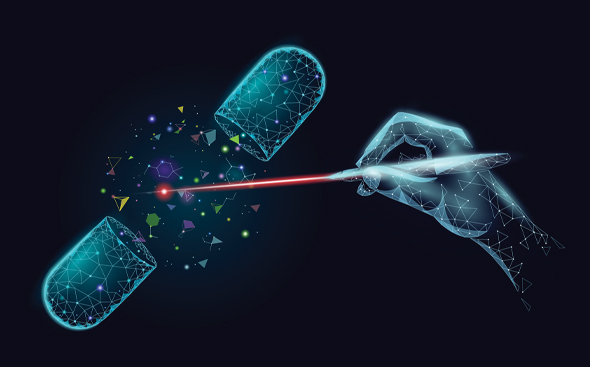 Perhaps the most transformative application of AI is in de novo drug design, where generative models create entirely new molecules
optimized for specific therapeutic profiles. Several architectures are pivotal:
Perhaps the most transformative application of AI is in de novo drug design, where generative models create entirely new molecules
optimized for specific therapeutic profiles. Several architectures are pivotal:
- Recurrent Neural Networks (RNNs): These models learn chemical grammar from SMILES (Simplified Molecular-Input Line-Entry System) strings to generate novel molecular structures (16).
- Generative Adversarial Networks (GANs) and Variational Autoencoders (VAEs): These models learn from existing molecular data to generate new, diverse, and valid chemical structures with desired properties, such as high binding affinity and low toxicity (17).
- Reinforcement Learning (RL): RL frameworks can be combined with generative models to iteratively optimize molecules for multiple objectives simultaneously, such as maximizing efficacy while minimizing off-target effects. This has been successfully applied to design potent inhibitors for targets like JAK2 kinase (18).
- Diffusion Models: These newer models generate 3D molecules directly within the target's binding pocket, ensuring a high degree of structural complementarity (19).
These generative approaches have compressed discovery timelines from years to months and have led to the design of novel drug candidates for cancer, CNS disorders, and infectious diseases, with some entering clinical trials (20).
ADMET and Toxicity Prediction
Failures due to poor pharmacokinetic properties (Absorption, Distribution, Metabolism, and Excretion) and toxicity (ADMET) are a major cause of attrition in drug development (21). AI models can predict these properties with high accuracy based on a compound's chemical structure, allowing researchers to prioritize safer and more effective candidates early in the process. DL models can forecast everything from human intestinal absorption and blood-brain barrier permeability to cardiotoxicity and metabolic stability, significantly de-risking the development pipeline (22).
Optimizing Clinical Trials
Clinical trials are the most expensive and lengthy phase of drug development. Nonetheless, the use of AI offers several solutions to improve their efficiency and success rate:
- Patient Selection and Recruitment: AI algorithms can analyze electronic health records (EHRs) and genomic data to identify eligible patients for trials, optimizing cohort composition, and accelerating recruitment (23).
- Protocol Design and Optimization: AI can simulate trial outcomes based on historical data, helping optimize protocol design, including sample size, endpoints, and dosing regimens (24).
- Adaptive Trial Designs: AI enables real-time monitoring and analysis of trial data, enabling adaptive designs in which protocols can be modified based on interim results. This increases efficiency and the likelihood of success (25).
- Synthetic Control Arms and Digital Twins: AI facilitates the creation of synthetic control arms from real-world data, reducing the need for placebo groups (26). Digital twins - virtual replicas of patients allow for in silico testing of treatments, optimizing therapeutic strategies before clinical application (27).
Challenges and the Path Forward
Despite its transformative potential, integrating AI into drug discovery is not without challenges. High-quality, large-scale, and unbiased data are essential for training robust AI models, yet such datasets are often scarce or heterogeneous (28). The "black box" nature of many DL models poses a challenge for interpretability and transparency, which is critical for regulatory approval and clinical trust (20). Furthermore, ensuring the generated molecules are synthetically feasible remains a significant hurdle (29).
Ethical considerations, including data privacy, algorithmic bias, and accountability, must also be addressed (30). Regulatory bodies like the U.S. Food and Drug Administration (FDA) are adapting to this new landscape, but clear guidelines are still needed to ensure the safe and effective deployment of AI-driven technologies (31).
The future of AI in pharmacology is incredibly promising. The integration of AI with emerging technologies like multi-omics, blockchain for data security, and the Internet of Medical Things (IoMT) will further enhance personalized medicine (32). Explainable AI (XAI) will be crucial for building trust and ensuring transparency (33). The ultimate vision is a closed-loop, autonomous system where AI designs, synthesizes, and tests new drug candidates with minimal human intervention, dramatically accelerating the delivery of life-saving therapies to patients (34).
Conclusion
AI is no longer a futuristic concept in drug discovery but a practical, powerful tool reshaping the entire R&D pipeline. By tackling long-standing bottlenecks in target identification, drug design, and clinical development, AI is accelerating timelines, reducing costs, and increasing the probability of success. While significant challenges related to data, interpretability, and regulation remain, the synergistic combination of human expertise and machine intelligence is paving the way for a new era of pharmaceutical innovation. As AI technologies continue to mature, they hold the potential to deliver safer, more effective, and personalized medicines faster than ever before, heralding a transformative impact on global health.
References
- Liu, Y.-T.; Zhang, L.-L.; Jiang, I. Z.-Y.; Applications of Artificial Intelligence in Biotech Drug Discovery and Product Development. Medcomm 2025; 6:e70317.
- Ocana, A.; Pandiella, A.; Privat, C.; Bravo, I.; Luengo-Oroz, M.; Amir, E.; Gyorffy, B. Integrating artificial intelligence in drug discovery and early drug development: a transformative approach. J Exp Clin Cancer Res 2025, 44 (1)
- Singh, S.; Kumar, R.; Payra, S.; Singh, S. K. Artificial Intelligence and Machine Learning in Pharmacological Research: Bridging the Gap Between Data and Drug Discovery. Cureus 2023, 15 (8), e44359.
- Hughes, J. P.; Rees, S.; Kalindjian, S. B.; Philpott, K. L. Principles of early drug discovery. Br J Pharmacol 2011, 162 (6), 1239–1249.
- Camacho, D. M.; Collins, K. M.; Powers, R. K.; Costello, J. C.; Collins, J. J. Next-Generation machine learning for biological networks. Cell 2018, 173, 1581–1592.
- You, Y.; Lai, X.; Pan, Y.; et al. Artificial intelligence in cancer target identification and drug discovery. Signal Transduct Target Ther 2022, 7, 1–24.
- Sidorova, O. V.; Isaeva, M. P.; Khomenko, V. A.; et al. [Yersinia pseudotuberculosis mutant OmpF porins with deletions of the external loops: genetic constructions design, expression, isolation and refolding]. Bioorg Khim 2012, 38 (2), 156–165.
- Brown, N.; Fiscato, M.; Segler, M. H.; Vaucher, A. C. GuacaMol: benchmarking models for de novo molecular design. J Chem Inf Model 2019, 59 (3), 1096–1108.
- Jumper, J.; Evans, R.; Pritzel, A.; et al. Highly accurate protein structure prediction with alphafold. Nature 2021, 596 (7873), 583–589.
- Hopkins, A. L.; Groom, C. R. The druggable genome. Nat Rev Drug Discov 2002, 1 (9), 727–730.
- Gómez-Bombarelli, R.; Wei, J. N.; Duvenaud, D.; et al. Automatic chemical design using a data-driven continuous representation of molecules. ACS Cent Sci 2018, 4 (2), 268–276.
- Sorkun, M. C.; Astruc, S.; Koelman, J. V.; Er, S. An artificial intelligence-aided virtual screening recipe for two-dimensional materials discovery. Npj Comput Mater 2020, 6 (1), 66.
- Tropsha, A.; Isayev, O.; Varnek, A.; Schneider, G.; Cherkasov, A. Integrating QSAR modelling and deep learning in drug discovery: the emergence of deep QSAR. Nat Rev Drug Discov 2024, 23, 141–155.
- Kearnes, S.; McCloskey, K.; Berndl, M.; Pande, V.; Riley, P. Molecular graph convolutions: moving beyond fingerprints. J Comput Aided Mol Des 2016, 30 (8), 595–608.
- Schneider, G. Automating drug discovery. Nat Rev Drug Discov 2018, 17 (2), 97–113.
- Liu, Y.; Zhang, L.; Wang, Y.; et al. Generative deep learning enables the discovery of a potent and selective RIPK1 inhibitor. Nat Commun 2022, 13 (1), 3469.
- Skalic, M.; Jiménez, J.; Sabbadin, D.; De Fabritiis, G. Shape-based generative modeling for de novo drug design. J Chem Inf Model 2019, 59 (3), 1205–1214.
- Popova, M.; Isayev, O.; Tropsha, A. Deep reinforcement learning for de novo drug design. Sci Adv 2018, 4 (7), eaap7885.
- Qiao, A.; Zhang, H.; Yuan, Q.; et al. A 3D Pocket-aware and Evolutionary Conserved Interaction Guided Diffusion Model for Molecular Optimization. arXiv 2025.
- Niazi, S. K.; Mariam, Z. Artificial intelligence in drug development: reshaping the therapeutic landscape. Ther Adv Drug Saf 2025, 16.
- Zhang, D.; Luo, G.; Ding, X.; Lu, C. Preclinical experimental models of drug metabolism and disposition in drug discovery and development. Acta Pharm Sin B 2012, 2 (6), 549–561.
- Wu, F.; Zhou, Y.; Li, L.; et al. Computational approaches in preclinical studies on drug discovery and development. Front Chem 2020, 8, 726.
- Harrer, S.; Shah, P.; Antony, B.; Hu, J. Artificial intelligence for clinical trial design. Trends Pharmacol Sci 2019, 40 (8), 577–591.
- Bretz, F.; et al. Adaptive designs for confirmatory clinical trials. Stat Med 2009, 28 (8), 1181–217.
- Kairalla, J. A.; Coffey, C. S.; Thomann, M. A.; Muller, K. E. Adaptive trial designs: a review of barriers and opportunities. Trials 2012, 13, 145.
- Thorlund, K.; Dron, L.; Park, J. J.; Mills, E. J. Synthetic and external controls in clinical trials: A primer for researchers. Clin Epidemiol 2020, 12, 457–467.
- Bordukova, M.; Makarov, N.; Rodriguez-Esteban, R.; Schmich, F.; Menden, M. P. Generative artificial intelligence empowers digital twins in drug discovery and clinical trials. Expert Opin Drug Discov 2024, 19 (1), 33–42.
- Kant, S.; Deepika; Roy, S. Artificial intelligence in drug discovery and development: transforming challenges into opportunities. Artif Intell Life Sci 2025.
- Gao, W.; Coley, C. W. The Synthesizability of Molecules Proposed by Generative Models. Journal of Chemical Information and Modeling 2020, 60 (12), 5714–5723.
- Forcier, M. B.; Gallois, H.; Mullan, S.; Joly, Y. Integrating artificial intelligence into health care through data access: can the GDPR act as a beacon for policymakers? J Law Biosci 2019, 6 (1), 317–335.
- Shaki, F.; et al. Artificial intelligence in pharmaceuticals: exploring applications and legal challenges. Pharm Biomed Res 2024, 10 (1), 1–10.
- Raza, M. A.; Aziz, S.; Noreen, M.; Saeed, A.; Anjum, I.; Ahmed, M.; Raza, S. M. Artificial intelligence (AI) in pharmacy: overview of innovations. Innov Pharm 2020, 13 (2).
- Murdoch, B. Privacy and artificial intelligence: challenges for protecting health information in a new era. BMC Med Ethics 2021, 22 (1), 122.
- Fleming, N. How artificial intelligence is changing drug discovery. Nature 2018, 557, S55–S57.